Project Profile: Keeping EchoWater Cool (Without Stopping the Flow)
Project Location: Sacramento, CA
On-Site Leadership: Joel Perez (Project Manager) & Nick Elliott (Field Superintendent)
Electrical Partner: Con J. Franke Electric
Think about what happens every time you flush the toilet, run the dishwasher, or turn on the kitchen tap. That wastewater doesn't vanish into thin air — it travels to a massive water reclamation facility that runs 24 hours a day, 365 days a year to clean the water, return it safely to the environment, and protect public health. A wastewater treatment plant is an industrial machine that simply cannot take a day off. If it stops, the community it serves stops with it. Right now, the Con J. Franke Electric team is on-site at the EchoWater Resource Recovery Facility, doing some of the most technically demanding work in our 100-year history. We aren't just running wire — we're rebuilding the invisible electrical backbone that keeps this entire essential operation from overheating.
The Mission: What Does a Chiller Plant Actually Do?
Think of the chiller system as the facility's central air conditioning plant — one that never turns off. It generates a continuous supply of chilled water and distributes it throughout the entire site to cool buildings, control rooms, electrical equipment rooms, and massive industrial machinery. Because EchoWater runs continuously, reliable cooling isn't a convenience — it's a hard requirement. If the cooling system fails, critical electronics and motors overheat, and the water treatment services the community depends on are directly at risk. Our job is to completely modernize the electrical network that powers this cooling plant. That means:
- Removing aging infrastructure and replacing it with equipment built for decades of reliable service
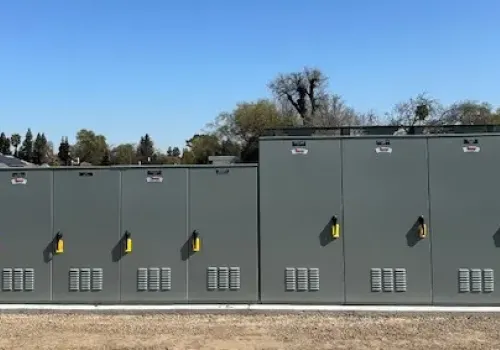
- Installing new switchgear — the master circuit-protection system that controls and safeguards the main power flow to the entire cooling plant
- Installing Motor Control Centers (MCCs) — the sophisticated control panels that act as the command system for the large electric motors driving the site's pumps, fans, and chillers
- Building the heavy-duty electrical foundation that will support the brand-new chiller system from the ground up
Built to Scale: The Project by the Numbers
The scale of this job is difficult to overstate. Our crews are currently managing logistics and installations across every level of the electrical scope:
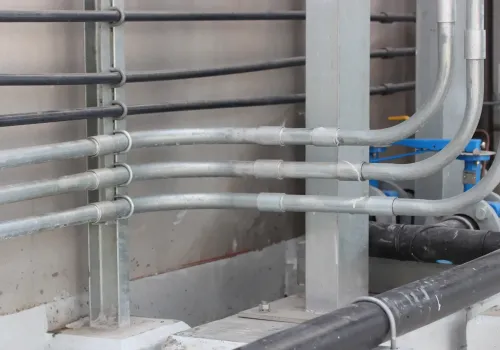
- Thousands of feet of conduit and electrical bus duct — the protective pipes and enclosed metal channels that route power safely throughout the facility
- Over a mile of medium-voltage cable — exceptionally thick, heavy conductors built to deliver high-voltage power to the plant's largest machines
- Multi-ton owner-furnished transformers weighing more than 13,000 pounds each — moving these requires specialized rigging crews and heavy-lift cranes just to position them From precise control wiring to steel equipment that weighs as much as a loaded dump truck, this project covers virtually every scale of electrical work. The standard is the same across all of it: every wire pulled, every conduit run, every panel mounted has to be exactly right. That's been true since 1925, and it's true today.
The Ultimate Challenge: No Shutdowns Allowed
Here's what separates a project like this from standard commercial construction: EchoWater can never stop running. There's no master switch to flip, no two-week shutdown window to work inside. The facility stays fully active throughout construction. Every task — every wire splice, every panel swap, every equipment transfer — must be planned with surgical precision to ensure the plant never experiences a power interruption. To govern that process, we operate under a strict Access Request (AR) system. Before our team touches a live circuit, we develop an exhaustive work plan that details:
- Exactly what work is being performed and which plant systems are in the vicinity
- The safety protocols and protective measures our crews will follow
- Contingency measures and a restoration procedure to maintain operations under any scenario Every plan is reviewed and approved by plant operations and project stakeholders before work begins. It's a demanding process — and it's the only way to keep construction moving while the community's water service runs without a single hitch.
The Phased Switchover: One Careful Step at a Time
One of the most technically complex milestones of the project is transitioning the facility from the existing cooling system to the brand-new one. Because the cooling cannot lapse, the transition must happen in carefully sequenced phases. The contract requires that Chillers 1 and 3 remain fully operational while we build the new system alongside them. The new chillers, pumps, switchgear, Motor Control Centers, and digital controls must be completely installed, started up, tested, and formally accepted by the District before any cutover can take place. Once the new system is proven operational, our team will coordinate the final transfer. The contract holds us to a tightly restricted shutdown window — requiring precise timing and close coordination between our field crews, the District, plant operators, and site engineers. Every step is documented and pre-approved through the AR process before anyone moves.
A 13,000-Pound Logistics and Seismic Puzzle
The project also involves installing large transformers that the District purchased directly and had delivered to the site before construction began. Moving them is far from simple. Each unit weighs several tons, requiring specialized rigging equipment to safely maneuver them into tight spaces within an active facility. Beyond the physical challenge, California's seismic codes require that equipment this heavy be engineered to withstand earthquake forces. Before a single anchor bolt was set, our team worked in close coordination with the design engineers to verify the seismic anchorage calculations and confirm every installation detail — ensuring this equipment stays permanently and safely in place.
It Takes a Village: On-Site Leadership & Teamwork
A project with this many moving parts demands experienced leadership and constant, precise communication. Joel Perez, Project Manager — the driving force behind schedules, contracts, submittals, and coordination from the earliest planning stages through final commissioning. Nick Elliott, Field Superintendent — the on-site leader directing our crews daily, managing sequencing, and ensuring every piece of physical work is executed safely and precisely inside the live plant. Success on this job also depends on close coordination with every other trade on site. Our electrical scope connects directly to mechanical chillers, cooling towers, heavy piping networks, and automated controls — which means staying in constant alignment with the mechanical, structural, civil, and controls contractors. Daily coordination meetings, shared 3D building models (BIM), and joint submittal reviews keep every trade in sync and the project moving safely forward.
Where We Stand Today
The project is currently in active construction. Our field crews are in the ground and in the structures — completing large underground excavations, setting conduit banks with structural spacers, and running heavy 5-inch and 6-inch conduit. This underground network is the primary power highway that will eventually feed the indoor switchgear, Motor Control Centers, transformers, and chillers above. Once construction activities are complete, the project shifts into the highly technical testing, startup, and commissioning process — bringing the new cooling plant fully online and transferring service from the existing system.
The Franke Standard
Projects like EchoWater require expertise that isn't built in a year or two: high-voltage distribution, large-scale motor control, and the discipline to execute complex electrical work inside a live facility where a power interruption is not an option. These skills are built over a century of showing up for California's most mission-critical infrastructure. When the stakes are highest — when the plant can't stop, the equipment weighs tons, and every move must be approved before it's made — this is the work Con J. Franke Electric was built for. 24/7 reliability isn't a suggestion. It's our promise.