The Don Pedro Powerhouse has been running since 1968. Fifty-six years of turbines spinning, megawatts flowing, and most people in the Central Valley never giving it a second thought. That's exactly how good infrastructure is supposed to work — until it's time for a rebuild.
Con J. Franke (CJF) is partnering with TCB Industrial, Inc. on a multi-year modernization of the facility. The goal: extend the powerhouse's operational life by another 50 years. The work that goes in now should still be running in 2076.
A massive mechanical and electrical overhaul
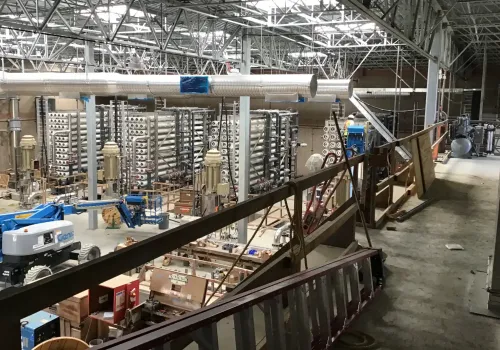
While CJF is leading the electrical and controls portion of the project, it is important to understand the sheer scale of the work happening on-site. Our partners at TCB Industrial are performing a complete mechanical overhaul, replacing the entire system from the ground up—including the massive turbines, generators, unit housing, and all associated mechanical systems.
This is far more than a simple tune-up; it is a total strip-down and rebuild of the powerhouse’s internal organs. CJF’s role is to provide the "nervous system" and "brain" that will power and control these massive new mechanical components.
A site-wide investment
CJF's scope is one piece of a much larger puzzle. While our crews are deep in the electrical systems, the Turlock Irrigation District (TID) is simultaneously upgrading the switchyard, the Hollow Jet Flood Control Valve, and infrastructure along the top of the dam and its spillway. It's a coordinated, site-wide overhaul — not a patch job.
What we're installing
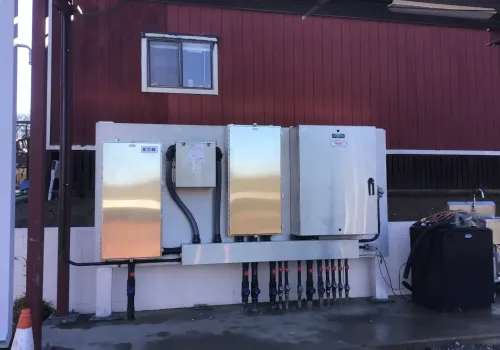
The heart of our electrical scope supports three massive hydro-electrical turbine generators. Under the hood, that means:
- Medium voltage transformers and bus-ducts
- Motor Control Centers (MCCs)
- Excitation units and generator governors
- RTU cabinets and custom control panels
On the controls side, we're installing PLCs, SCADA, and Human Machine Interfaces—essentially giving a 1960s workhorse a 21st-century brain. This provides more precise monitoring, more efficient operations, and the kind of visibility operators couldn't have imagined when this facility first came online.
Clean energy by the numbers
The modernization will push the site's hydroelectric output from just over 200 megawatts to more than 260 megawatts. That's enough clean, renewable energy to power more than 150,000 homes — carbon-free, and generated right here in the Central Valley.
Working with a moving design
We joined this project alongside GE Vernova when the design was roughly 75% complete, which meant real engineering decisions were still being made while we were planning our approach. The 100% drawings only recently landed.
Our answer to that is straightforward: treat the first of the three units as a learning lab. Every lesson from unit one gets folded into the plan for units two and three. It keeps costs down and lets us get sharper as the job progresses — which is the only sensible way to run a retrofit when the blueprint is still evolving.
The team
Project Manager Joel Perez and Foreman Dustin King are leading the on-site effort. Point 1 Electrical Systems is handling the fiber installation and terminations. We're in early mobilization right now, but the crew already understands the weight of what they're building. There's something grounding about work that you know will outlast you.
More than the grid
Don Pedro Lake holds more than 2 million acre-feet of water storage — a genuine lifeline for the farmers and residents who depend on it. The facility is also a critical piece of the region's flood control infrastructure, and the reservoir draws boaters, campers, and anglers from across the Central Valley.
Upgrading the powerhouse touches all of it. This is the kind of project where installing wire and conduit connects directly to whether people have water, whether homes stay dry in a flood year, and whether the lights stay on for the next half-century. That's what "Powering What Matters" actually means in practice.